
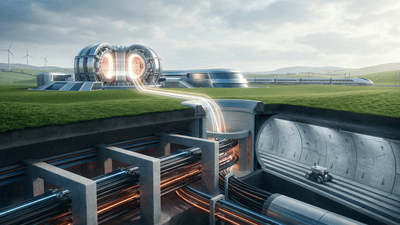



The United Kingdom's energy infrastructure is currently undergoing its most radical transformation since the mid-20th century. For engineering professionals, we have moved past the era of theoretical white papers and policy debates; we are now firmly in the delivery phase of a multi-billion-pound energy renaissance. From the complex physics of nuclear fusion becoming concrete engineering reality in Nottinghamshire, to the subterranean rewiring of our capital's power grid, the sector is experiencing a convergence of unprecedented technical challenges and commercial opportunities.
This shift is not reliant on a single technology. Instead, the UK's strategy relies on a diversified portfolio: commercialising experimental fusion, standardising Small Modular Reactors (SMRs), completing legacy mega-projects with stringent ecological safeguards, and fundamentally upgrading the transmission grid. For contractors, consultants, and the wider supply chain, understanding the distinct engineering demands of these concurrent projects is essential for future-proofing operations.
Fusing the Future: The STEP Programme
In a watershed moment for British engineering, a consortium led by a Kier and Nuvia joint venture has secured the first £200m tranche of the UK's Spherical Tokamak for Energy Production (STEP) programme. Located at West Burton in Nottinghamshire, this project aims to deliver a prototype fusion energy plant, moving the technology out of the laboratory and onto the grid.
The engineering implications of STEP are staggering. Unlike traditional fission reactors, a fusion plant requires containing plasma at temperatures exceeding 100 million degrees Celsius. For the Kier-Nuvia JV, the immediate challenge lies in the early-stage site development, infrastructure design, and establishing a supply chain capable of delivering unprecedented material tolerances.
"The STEP programme is not just a scientific endeavour; it is a profound civil and structural engineering challenge. Delivering the facilities to house and support a spherical tokamak requires a fundamental rethink of nuclear construction methodologies, focusing on advanced materials, seismic resilience, and hyper-precise modular assembly."
Small Modular Reactors: Standardising Nuclear Delivery
While fusion represents the long-term horizon, Small Modular Reactors (SMRs) are the medium-term pragmatic solution designed to provide baseload clean energy. The strategy relies heavily on shifting nuclear construction from bespoke, on-site mega-builds to standardised, factory-manufactured components.
This pivot was recently cemented when Mace and Arup were selected to spearhead the early engineering and delivery strategy for the UK's first SMR project at Wylfa in North Wales. The appointment of these engineering heavyweights underscores a critical industry shift: treating nuclear power generation as an advanced manufacturing and logistics challenge rather than purely a traditional civil engineering endeavour.
- Design for Manufacture and Assembly (DfMA): SMRs will require engineers to design components that can be mass-produced off-site and transported via standard logistics networks.
- Regulatory Navigation: Mace and Arup will need to pioneer new frameworks for regulatory approval that accommodate modular, repeatable designs rather than site-specific evaluations.
- Site Integration: The civil works at Wylfa will focus heavily on preparing the ground to receive modular units, demanding high-precision foundation engineering.
Mega-Projects and Ecological Engineering: Hinkley Point C
As next-generation nuclear takes shape, the UK's current mega-project, Hinkley Point C, continues to push the boundaries of civil engineering, particularly concerning environmental mitigation. Balancing massive energy outputs with ecological stewardship is a defining challenge of modern infrastructure.
Currently, engineers at the Somerset site are preparing to commence tunnelling for the second of three critical fish protection measures. This involves constructing a complex system of tunnels designed to safely return marine life to the Bristol Channel, preventing them from being drawn into the plant's massive cooling water systems.
This project highlights a crucial reality for UK engineers: major infrastructure delivery is now inextricably linked to advanced environmental engineering. Tunnelling in a live nuclear construction environment, beneath a sensitive marine ecosystem, requires extraordinary precision, vibration control, and real-time geotechnical monitoring.
Rewiring the Capital: The Thames Power Tunnel
Generating clean power is only half the equation; transmitting it efficiently to areas of high demand requires equally ambitious infrastructure. The UK's transmission grid must be radically upgraded to handle the influx of new nuclear and renewable energy.
In London, this is manifesting as a massive subterranean engineering effort. Preparations are currently underway for the launch of a Tunnel Boring Machine (TBM) for the new Thames power tunnel project. This critical grid reinforcement will thread high-voltage cables beneath the River Thames, navigating a densely packed subterranean landscape of existing transport tunnels, utilities, and historic foundations.
Comparing the UK's Energy Infrastructure Pillars
To understand the breadth of the current energy transition, it is helpful to categorize the engineering demands across these distinct project types:
| Project Type | Key Example | Primary Engineering Focus | Delivery Horizon |
|---|---|---|---|
| Experimental Fusion | STEP (West Burton) | Advanced materials, extreme thermal tolerance, prototype civil structures. | 2040s (Commercial viability) |
| Modular Fission | Wylfa SMR | DfMA, logistics, standardized modular assembly, regulatory pathfinding. | Early 2030s |
| Legacy Mega-Nuclear | Hinkley Point C | Massive-scale civil engineering, ecological mitigation, complex tunnelling. | Late 2020s / Early 2030s |
| Grid Resilience | Thames Power Tunnel | Urban TBM operations, high-voltage integration, brownfield geotechnical engineering. | Ongoing / Near-term |
Practical Implications for UK Professionals
For engineering firms operating in the UK, this multi-tiered approach to energy infrastructure dictates a strategic pivot. The traditional silos between civil, mechanical, and environmental engineering are dissolving.
- Supply Chain Adaptation: Firms that previously supplied traditional commercial construction must upgrade their quality assurance and documentation processes to meet the stringent demands of nuclear (both fusion and fission) environments.
- Cross-Disciplinary Skills: Project managers who can integrate complex mechanical systems (like TBMs or modular reactor cores) with sensitive ecological mandates (like the Hinkley fish tunnels) will be at a premium.
- Digital Rehearsal: Because projects like STEP and Wylfa involve first-of-a-kind delivery models, the use of digital twins and 4D BIM for "digital rehearsal" prior to physical construction is no longer optional; it is a baseline requirement for securing contracts.
Ultimately, the announcements surrounding Kier, Nuvia, Mace, and Arup signal a profound maturation of the UK market. The theoretical discussions regarding how to achieve energy security and net-zero targets have ended. We are now in the era of heavy steel, deep tunnels, and modular assembly. For the UK engineering sector, the challenge is immense, but the opportunity to physically build the next century's power network is unparalleled.