
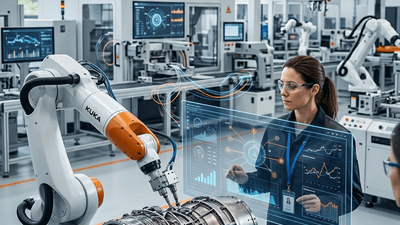



The Digital Squeeze: Doing More with Less in UK Engineering
In the high-stakes arena of UK manufacturing and engineering, a quiet revolution is taking place on the factory floor and out in the field. Faced with mounting economic pressures and increasingly complex supply chains, firms are rapidly turning to digital solutions to squeeze every ounce of efficiency from their existing operations. But this technological sprint is occurring against a troubling backdrop: the foundational human pipeline that has historically powered British industry is drying up.
Today, the industry finds itself at a unique crossroads. We are witnessing unprecedented advancements in how physical and cognitive assets are managed—from telematics tracking high-value machinery to generative artificial intelligence slashing engineering response times. Yet, as the sector becomes smarter, it is also becoming increasingly top-heavy, risking a future where we have the world's most advanced tools, but too few skilled hands to guide them.
Physical Asset Optimization: The Merlo UK Blueprint
One of the most immediate ways UK engineering firms are combating resource strain is through the granular tracking of physical assets. A prime example is telescopic handler manufacturer Merlo UK, which recently implemented a targeted machinery tracking system to gain real-time visibility across its demonstration fleet.
Historically, the focus of telematics has been on the heavy machinery itself—the tractors, the excavators, the telehandlers. However, the high-value, specialized attachments that make these machines versatile often slip through the cracks of asset management, leading to lost time, misplaced equipment, and unnecessary capital expenditure.
By integrating the ABAX Worksite system, Merlo UK has achieved full visibility of these critical attachments. For engineering and construction professionals, the practical implications of this shift are significant:
- Reduced Downtime: Site managers no longer waste billable hours locating specific attachments across sprawling sites or multiple depots.
- Capital Efficiency: Real-time tracking prevents the "phantom loss" of equipment, reducing the need to purchase redundant replacements.
- Data-Driven Deployment: Analyzing the utilization rates of specific attachments allows firms to make informed procurement and logistical decisions based on actual usage rather than guesswork.
This localized application of the Internet of Things (IoT) represents a broader trend: UK firms are recognizing that true operational efficiency requires visibility into the micro, not just the macro, components of their fleet.
Cognitive Asset Optimization: AI Cuts Response Times by 67%
While IoT is optimizing physical assets, Artificial Intelligence is revolutionizing the cognitive workload of UK engineers. For years, the promise of generative AI in heavy industry was largely theoretical. Now, the data proving its efficacy is undeniable.
A recent year-long collaboration between Instro AI Solutions and AMRC Cymru has delivered measurable gains for UK manufacturers. The trials, which involved several engineering businesses across the country, demonstrated that generative AI software dramatically improved how staff found technical information and supported engineering decisions.
The headline metric is staggering: engineering response times were cut by nearly two thirds (67%). In an industry where technical queries, compliance checks, and troubleshooting can stall production lines, this acceleration translates directly to the bottom line.
| Operational Metric | Traditional Workflow | AI-Assisted Workflow | Net Impact |
|---|---|---|---|
| Technical Document Retrieval | Manual search through legacy systems and physical manuals | Natural language querying via generative AI | Instant access, reducing search time by hours |
| Engineering Response Time | Baseline (100%) | 33% of Baseline | 67% Reduction in time-to-resolution |
| Decision Support | Relying on senior engineers for routine technical queries | AI surfaces relevant historical data and specs instantly | Frees up senior talent for complex problem-solving |
This AI integration does not replace the engineer; it augments them. By acting as a highly efficient, tireless research assistant, AI allows UK engineering teams to punch significantly above their weight, managing larger workloads without proportional increases in headcount.
The Talent Deficit: A Disappearing Entry Point
The simultaneous adoption of IoT and AI paints a picture of a highly advanced, optimized UK engineering sector. However, this technological acceleration is acting as a temporary bridge over a widening chasm: the collapse of the industry's entry-level talent pipeline.
According to recent data, the entry point into the engineering profession is rapidly disappearing. Between 2017 and 2024, the number of Level 2 engineering apprenticeship starts fell by a catastrophic 50 percent. This sharp decline threatens to cut off access to engineering careers before they even begin, particularly for young people from disadvantaged backgrounds who traditionally rely on Level 2 apprenticeships as a vital stepping stone.
"A sharp fall in entry-level apprenticeships risks cutting off access to engineering careers before they even begin. If we do not rebuild the foundation of our skills pipeline, the UK will lack the hands-on workforce required to maintain, operate, and innovate our future infrastructure."
This creates a dangerous paradox. As systems become more technologically advanced, they require a workforce that understands both the digital interface and the physical mechanics of the machinery. AI can tell an engineer how to fix a complex hydraulic fault on a Merlo telehandler 67% faster, but it cannot turn the wrench. If the UK fails to train the next generation of hands-on technicians, the operational gains won by digital transformation will be lost to a critical shortage of human capital.
Strategic Implications for UK Engineering Leaders
To navigate this complex landscape, engineering directors, operations managers, and CTOs must adopt a dual mandate: ruthlessly optimize current operations with technology while actively rebuilding the talent pipeline. Here are the practical steps professionals must consider:
- Democratize Tech to Aid Junior Staff: Use AI not just to speed up senior engineers, but to accelerate the training of junior staff. Generative AI can serve as a "co-pilot" for apprentices, helping them understand complex schematics faster and bridging the knowledge gap left by retiring veterans.
- Leverage IoT for Safer Training: Systems like ABAX Worksite provide a wealth of data on how machinery is used. This data can be utilized to create highly accurate, real-world training modules for apprentices, ensuring they learn best practices based on actual site data.
- Reinvest Efficiency Gains into Apprenticeships: The capital and time saved by a 67% reduction in engineering response times must not just pad the bottom line. Forward-thinking firms will ring-fence a portion of these savings to fund internal training programs, subsidize Level 2 apprenticeships, and engage with local educational institutions.
- Advocate for Policy Shifts: The industry must collectively pressure policymakers to reform the Apprenticeship Levy and provide better funding for Further Education (FE) colleges to reverse the decline in Level 2 starts.
Conclusion: Fusing Silicon and Sweat
The UK engineering sector is proving its resilience and adaptability. By embracing tools like ABAX's IoT tracking and Instro's generative AI, manufacturers are proving they can innovate their way out of immediate operational bottlenecks, achieving remarkable efficiency gains in the process.
However, the long-term sovereign capability of UK engineering cannot be sustained by software alone. The alarming halving of entry-level apprenticeships is a klaxon warning that our foundation is cracking. The true test for the industry over the next decade will not just be how smartly we can deploy artificial intelligence, but whether we can use those technological advantages to buy enough time to rebuild our human intelligence. The future of British engineering relies on successfully fusing cutting-edge silicon with the traditional sweat of a well-trained, highly skilled workforce.