



When engineering professionals picture the construction of High Speed 2 (HS2), the mind naturally gravitates toward colossal tunnel boring machines, sweeping viaducts, and the raw logistics of earthmoving. Yet, the true complexity of a 21st-century railway lies not just in its concrete and steel, but in its digital nervous system. The recent contract award for the HS2 Washwood Heath depot and network integrated control centre (NICC) is a masterclass in this evolution, signalling a definitive shift from traditional civil engineering to deep digital systems integration.
Situated in the heart of Birmingham, the Washwood Heath site is poised to become the operational brain of the entire HS2 network. For UK engineering professionals—whether in civil, electrical, software, or systems disciplines—this development represents far more than a regional infrastructure win. It is a live proving ground for the convergence of physical infrastructure and digital engineering capabilities.
The Anatomy of Washwood Heath: More Than a Depot
To understand the engineering significance of the Washwood Heath contract, we must look beyond the term "depot." Historically, rail depots were fundamentally mechanical spaces—sheds designed for heavy lifting, lubrication, and manual component replacement. Washwood Heath upends this paradigm.
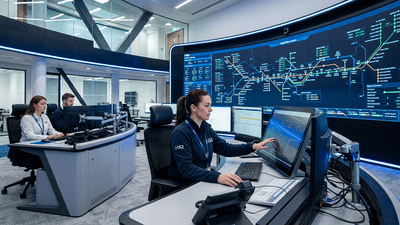
The facility is dual-purpose. First, it will serve as the primary maintenance hub for the HS2 rolling stock, requiring precision automated inspection systems and state-of-the-art diagnostic bays. Second, and perhaps more crucially, it will house the Network Integrated Control Centre (NICC). The NICC will manage the real-time operations of the entire high-speed network, overseeing everything from signalling and power distribution to passenger information and security protocols.
"The integration of a maintenance depot with a central network control centre demands a frictionless flow of data. We are no longer just building facilities to house trains; we are building data centres that happen to process physical rolling stock."
The Systems Integration Challenge
The core engineering challenge at Washwood Heath is systems integration. The successful consortium will need to weave together disparate, highly complex subsystems into a singular, fault-tolerant operational matrix. This involves:
- SCADA (Supervisory Control and Data Acquisition): Managing traction power across the network with microsecond precision.
- ETCS (European Train Control System): Interfacing the depot's local signalling with the Level 2 high-speed signalling of the mainline.
- Predictive Maintenance Algorithms: Utilising trackside sensors and onboard telemetry to predict component degradation before failure occurs, directing trains to specific maintenance bays at Washwood Heath automatically.
Digital Engineering: The New Baseline
The phrasing of the contract award explicitly highlights the need for "deep rail systems and digital engineering capability." But what does this mean in practice for the engineers on the ground?
Firstly, it cements Building Information Modelling (BIM) and digital twin technology as non-negotiable baselines. The entire Washwood Heath facility will exist as a fully federated 3D and 4D digital model long before the first foundation is poured. This digital twin will not only guide the clash-detection and construction phases but will transition into the operational phase as a live asset management tool.
Let's examine how the engineering approach at Washwood Heath contrasts with traditional rail infrastructure:
| Engineering Domain | Traditional Rail Approach | Washwood Heath (Digital-First) Approach |
|---|---|---|
| Maintenance Scheduling | Mileage-based or reactive (run-to-failure). | Predictive, condition-based maintenance driven by real-time telemetry. |
| Network Control | Siloed desks for power, signalling, and traffic. | Integrated dashboards utilizing AI for conflict resolution and traffic optimization. |
| Facility Management | Static 2D CAD drawings and manual asset registers. | Live Digital Twin linked to IoT sensors for energy and space optimization. |
For UK engineering supply chains, this necessitates an upskilling in data interoperability. Subcontractors providing HVAC, lighting, or specialized maintenance gantries must ensure their systems can "talk" to the central NICC via open-standard APIs. The mechanical engineer and the software engineer must now speak the same language.
Catalysing the West Midlands Engineering Ecosystem
Beyond the technical marvels, the Washwood Heath development is a potent catalyst for regional economic and professional growth. The site itself is steeped in engineering history, having formerly been the home of Metro-Cammell, where generations of Birmingham engineers built railway carriages for the world.
The HS2 contract revitalises this legacy, but upgrades it for the 21st century. The project is projected to create hundreds of highly skilled jobs, transitioning the local workforce from traditional heavy manufacturing to advanced digital systems engineering. This is a vital injection of high-value capability into the West Midlands.
Opportunities for the Supply Chain
The sheer scale of the Washwood Heath depot means that tier-one contractors cannot deliver it in isolation. There is a vast, immediate opportunity for SMEs and specialized engineering firms across the UK. Key areas of demand include:
- Cyber-Physical Security: As the depot and NICC are highly connected, securing industrial control systems against cyber threats is paramount. Specialists in OT (Operational Technology) security will be in high demand.
- Robotics and Automation: Automated inspection gates, robotic component handling, and automated guided vehicles (AGVs) for moving heavy parts within the depot.
- Sustainable Engineering: Designing the facility to meet stringent net-zero targets, incorporating advanced energy recovery systems, solar integration, and intelligent HVAC management.
The Road Ahead: A Blueprint for Future Mega-Projects
As early works and site preparations ramp up in Birmingham, the engineering community should watch Washwood Heath closely. It is not merely a component of HS2; it is a blueprint for how the UK will design, build, and operate smart infrastructure for the next fifty years.
The successful delivery of the NICC and maintenance depot will prove that the UK can execute complex, digitally native mega-projects. For engineering professionals, the message is clear: the boundaries between civil construction, mechanical engineering, and software development have permanently dissolved. The future belongs to the integrators—those who can look at a vast expanse of concrete and steel and see the flow of data that brings it to life.