
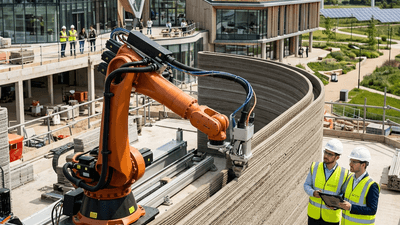



The transition to a net-zero economy is no longer just a boardroom discussion; it is being printed, layer by layer, onto the industrial landscapes of the United Kingdom. As the UK accelerates its decarbonisation agenda, civil engineering is undergoing a quiet but profound transformation. Traditional methods of pouring, setting, and curing are increasingly making way for automation, precision robotics, and advanced material science. We are witnessing the physical manifestation of climate policy, and the tools being used to build it are as innovative as the infrastructure itself.
Automating the Foundations of Carbon Capture
Nowhere is this shift more evident than in the North East of England. In a landmark move for UK infrastructure, Costain, in partnership with A E Yates, is deploying advanced robotics to 3D print 90 high-strength concrete bases. These are not standard structural components; they are the critical foundational supports for a sprawling pipeline network designed to carry captured carbon dioxide across Teesside.
This project is a cornerstone of the East Coast Cluster, a massive Carbon Capture, Utilisation, and Storage (CCUS) initiative aimed at decarbonising one of the UK's most carbon-intensive industrial regions. By capturing CO2 emissions from local heavy industries and transporting them via pipeline to be permanently stored beneath the North Sea, the project represents a monumental leap in the UK's net-zero journey.
The Mechanics and Merits of Robotic Extrusion
The decision to utilise 3D concrete printing for pipeline supports is not merely a technological gimmick; it is a calculated engineering strategy designed to optimise efficiency, safety, and sustainability. Traditional concrete bases require extensive formwork (often timber, which generates waste), significant manual labour for steel fixing and pouring, and lengthy curing times.
By contrast, robotic 3D printing extrudes a specially formulated, high-strength concrete mixture layer by layer, guided by precise digital models. This methodology offers several distinct advantages for UK engineering professionals:
- Material Efficiency: The robotic arm deposits concrete only where it is structurally required, creating complex, topologically optimised shapes that are impossible or cost-prohibitive to achieve with traditional timber shuttering. This drastically reduces the volume of cement used—a critical factor given cement's high embodied carbon.
- Programme Acceleration: Printing bases off-site or near-site in a controlled environment allows for continuous production, unhindered by adverse weather conditions. The speed of extrusion and rapid curing formulations mean components can be deployed to the trench much faster.
- Enhanced Site Safety: By automating the heavy lifting and eliminating the need for operatives to work in close proximity to poured concrete and temporary works, the risk profile of the construction site is significantly lowered.
- Quality Control: Digital fabrication ensures that every one of the 90 bases is identical, meeting exact tolerances required for the safe transport of highly pressurised carbon dioxide.
To understand the operational shift, consider the following comparison between traditional methods and the robotic printing approach adopted in Teesside:
| Metric | Traditional Concrete Pouring | Robotic 3D Concrete Printing |
|---|---|---|
| Formwork Required | Extensive (Timber/Steel), high waste | None (Self-supporting layers) |
| Material Usage | High (often over-engineered block shapes) | Optimised (material only where needed) |
| Labour Intensity | High (shuttering, pouring, vibrating, striking) | Low (machine operators, digital technicians) |
| Design Flexibility | Limited by formwork complexity and cost | High (complex geometries easily achieved) |
Cultivating the Next Generation of Innovators
While robots are transforming the physical landscape in Teesside, the intellectual foundation for the next wave of engineering breakthroughs is being laid further north. The technologies enabling Costain's 3D printed bases did not emerge in a vacuum; they are the result of decades of academic research, materials science, and computational engineering. To sustain this trajectory, the UK must continuously invest in the environments where future engineers learn and innovate.
This necessity has been powerfully addressed in Scotland, where McLaughlin & Harvey has successfully completed the University of Edinburgh's new Engineering Forum building. This state-of-the-art facility is designed specifically to foster the kind of cross-disciplinary collaboration that modern mega-projects demand.
Where Research Meets Reality
The new Engineering Forum is not just a collection of lecture theatres; it is a dynamic ecosystem built to bridge the gap between theoretical academia and practical, industry-ready innovation. Providing fresh spaces for learning, high-level research, and student-led innovation, the building acts as an incubator for the talent pipeline that the UK construction and infrastructure sectors desperately need.
"The future of UK engineering relies on our ability to seamlessly integrate digital design, robotics, and sustainable materials. Facilities like the Engineering Forum are where the next generation will experiment with these disciplines, turning today's radical ideas into tomorrow's standard site practices."
The completion of this facility by McLaughlin & Harvey highlights a crucial parallel track in the UK's infrastructure strategy. As we build physical pipelines to capture carbon, we must simultaneously build academic pipelines to capture talent. The students walking into the Engineering Forum today will be the project directors, computational designers, and robotics engineers managing the UK's infrastructure upgrades in 2035.
Modern engineering education requires modern facilities. The integration of advanced computational fluid dynamics (essential for pipeline design), robotics laboratories (essential for automated construction), and materials testing suites (essential for low-carbon concrete development) under one roof allows students to tackle holistic engineering challenges rather than siloed academic problems.
Conclusion: A Synchronised Engineering Ecosystem
The simultaneous developments in Teesside and Edinburgh paint a highly encouraging picture for the future of UK engineering. Costain's deployment of 3D concrete printing robots for the East Coast Cluster proves that the industry is ready to embrace disruptive technologies to meet stringent net-zero targets and deliver complex infrastructure safely and efficiently.
Meanwhile, McLaughlin & Harvey's delivery of the University of Edinburgh's Engineering Forum ensures that the UK remains a global powerhouse in engineering research and education. The synergy is undeniable: the cutting-edge practices being deployed on site today will be refined and advanced by the students inhabiting these new academic spaces tomorrow.
For engineering professionals, the message is clear. The boundary between digital design, automated manufacturing, and heavy civil construction is dissolving. Embracing this convergence—whether by upskilling in digital fabrication, adopting low-carbon materials, or engaging with academic institutions to shape the future curriculum—is no longer optional. It is the blueprint for building the next century of UK infrastructure.