Master pumping system design and piping installation to prevent costly errors and optimize hydraulic performance, ensuring reliability and efficiency in any environment.
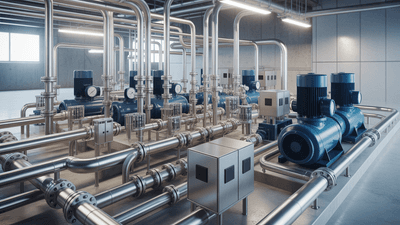
This course examines applications for various pumping and piping systems and components in the built environment. Topics include pump construction and operation, hydraulic principles, and calculations, design standards and codes, piping system components and materials, and pump and piping system troubleshooting.
Key learning outcomes include:
**Centrifugal Pump Operation**: Understand the selection, construction, and components of centrifugal pumps, including impellers, motors, and volutes. Learn the mechanics of incompressible fluid pumping and analyze closed, open, parallel, and series pumping applications through system curves. We will differentiate centrifugal pumps from positive displacement pumps, examining their optimal use cases based on flow rate, pressure, and fluid viscosity (including Newtonian and non-Newtonian liquids).
**Hydraulic Principles and Calculations**: Master the conversion between PSI and feet of head, understand Bernoulli's theorem, and apply pump affinity laws to predict pump performance under varying speeds and impeller diameters. Explore methods for calculating friction head loss using formulas like Hazen-Williams and Darcy-Weisbach. Critically, you will define and apply concepts of static and dynamic head, deciphering the nuances of suction lift, atmospheric pressure, and the critical issue of cavitation, including its causes and prevention in diverse environments. Practical exercises, such as a hands-on flow rate calculation for pipe sizing, enhance your analytical skills.
**Piping System Design & Materials**: Gain expertise in pipe sizing using fixture units and Hunter's Curve to determine domestic water demand. Evaluate friction losses within piping and account for equivalent lengths for various fittings and valves. Conduct real-world pipe sizing exercises that highlight the subtle interplay between engineering calculations and practical application. Analyze different piping materials—copper, plastic (PVC, CPVC, PEX, polypropylene), galvanized steel, and stainless steel—weighing their advantages, disadvantages, and specific applications, particularly focusing on thermal expansion, sound attenuation, and chemical resistance. Explore the complexities of galvanic corrosion and strategies for its prevention.
**Valves and Fittings**: Familiarize yourself with a wide range of valves, including ball, gate, butterfly, globe, needle, and check valves, understanding their operational characteristics and appropriate applications. Special attention is given to backflow preventers, distinguishing between RPZs and double-check valves, their installation requirements, and the impact of their discharge rates on drainage systems. Learn about water meters, pressure reducing valves (PRVs), and essential components like suction diffusers and water hammer arresters.
**Codes and Standards**: Navigate the intricate landscape of industry regulations, including the International Plumbing Code (IPC), International Mechanical Code (IMC), state amendments, NFPA codes (NFPA 20 for pumps, NFPA 99 for healthcare, NFPA 13 for sprinklers), ASHRAE standards (ASHRAE 90.1 for energy efficiency), Green Building Council (USGBC) standards, and specialized guidelines such as the Unified Facilities Criteria (UFC) for military projects and NIH design manuals. Understand the critical role of the Authority Having Jurisdiction (AHJ) and the impact of standards like NSF 61 on material selection.
By the end of this course, you will be equipped with the knowledge and practical skills to confidently design, analyze, and troubleshoot pumping and piping systems, ensuring efficiency, safety, and compliance with industry standards.

Online Courses for Engineers
HalfMoon Education is a nonprofit continuing education provider offering live webinars and on-demand courses for engineers, architects, landscape architects, land surveyors, attorneys, paralegals, accountants and others. Since 1996, we’ve helped thousands of professionals nationwide stay current with industry standards and codes, earn CE hours, and advance their expertise through practical, expert-led learning experiences. Learn more about us at: www.halfmoonseminars.org

Project Engineer at TLC Engineering Solutions
Mr. Walters is a professional engineer and is certified in plumbing design through the American Society of Plumbing Engineers. His responsibilities overlap into the professional engineering areas of civil engineering, mechanical engineering, chemical engineering, fire protection engineering, and process engineering. He performs calculations, sizes equipment, and prepares plumbing design and construction documents. Mr. Walters is a member of the Atlanta Chapter of the American Society of Plumbing Engineers (ASPE). He earned his B.S. degree in Mechanical Engineering from Georgia Tech.
